"Below the surface of the Earth's oceans lies a mysterious and relatively unknown world. With an enormous diversity of life, the ocean remains one of the world's largest ecosystems, though we still known very little about what lives in its great depths. Go beneath the water and learn more surprises of the sea:
* "Water covers more than three quarters of the globe.
* "We know the surface of Mars or Venus better than Earth's ocean floor.
* "Only about 5% of the global ocean floor has been mapped in detail.
* "Average ocean depths are approximately 2.2 miles, nearly 12,000 feet, deep.
* "The mid ocean ridges of the world are so long they could go right around the Earth one and a half times.
* "Overall, the diversity of the deep sea rivals that of rain forests on land.
* "There are up to 100,000 underwater mud volcanoes on continental slopes and abyssal plains – formed by gas escaping from some underground source under high pressure.
* "There are between 70,000 and 100,000 sea mounts more than half a mile tall in the world's ocean and as many as one million features over 328 feet tall.
* "The Mid Oceanic Ridge is the world's longest mountain chain being more than 35,000 miles, running along the center of the ocean basins and joining up around the globe like the seams on a basketball.
* "Iceland is one of the few places where you can stand on the Mid Atlantic ridge on dry land."

"A barrage of comets may have delivered Earth's oceans around 3.85 billion years ago, a new study suggests.
"Scientists have long suspected that Earth and its near neighbors were walloped by tens of thousands of impactors during an ancient event known as the Late Heavy Bombardment.
"This pummeling disfigured the moon, leaving behind massive craters that are still visible, preserved for millennia in the moon's airless environment. But it's been unclear whether the impactors were icy comets or rocky asteroids.
"Now, based on levels of a certain metal in ancient Earth rocks, a team led by Uffe Jorgensen of the Niels Bohr Institute in Denmark says comets were the culprits.
"Whether Earth had oceans before any comets arrived has been intensely debated, Jorgensen noted.
"Some experts say enough water could have existed from the moment Earth formed, while others argue that the young planet's heat would have vaporized any liquids.
""It's the kind of subject that can make scientists fight physically with one another," Jorgensen said.
"His team thinks early Earth was just too hot to retain large bodies of water. But by the time of the Late Heavy Bombardment, things had cooled down, allowing watermelon from the flurry of comets to become the world's first seas.
""We may sip a piece of the impactors every time we drink a glass of water," the study authors write in their paper, which will be published in an upcoming issue of the journal Icarus.
"Jorgensen and colleagues arrived at this conclusion after measuring the levels of iridium in surface and near-surface rocks from Greenland—some of the oldest known rocks in the world, dating back to the time of the bombardment.
"Iridium is a scarce metal on Earth, but it's relatively common in comets and asteroids.
"According to the team's calculations, iridium levels in the rocks around an asteroid impact should be about 18,000 parts per trillion.
"A comet impact, meanwhile, should leave behind only about 130 parts per trillion. That's because comets would carry less metal, since they're mostly made of loosely packed water ice with some rocky debris.
"Comets also strike Earth at higher speeds, because of their longer orbits around the sun.
"As a result, "the explosion formed by a comet is more violent than from an asteroid, and the amount of material—including iridium—thrown back into space is larger," Jorgensen said.
"The team found that the Greenland rocks contained about 150 parts per trillion of iridium, supporting the idea that comets were the main players in the Late Heavy Bombardment.
"All that ice from the comet swarm then thawed to create a global ocean more than half a mile (about a kilometer) deep, the team calculates.
"The moon, meanwhile, lacks an ocean because its gravity is much weaker than Earth's, so most if not all of the debris from a comet strike would be thrown back into space, Jorgensen said.
"But Nicolas Dauphas, a geophysicist at the University of Chicago, isn't yet convinced that the bombardment featured comets, not asteroids.
"The new study, he said, relies on too many estimates—such as the predicted amount of iridium deposited following an impact.
""I am afraid [they have] stretched their conclusions too far," Dauphas said.
Accidental Life?
"Chandra Wickramasinghe, an astrobiologist at Cardiff University in the U.K. not involved in the new study, also supports the theory of an ancient comet bombardment.
"And he thinks it's possible that comets seeded Earth not only with water but with life.
According to some controversial studies, the oldest evidence for life on Earth dates back to about 3.85 billion years ago, around the time of the Late Heavy Bombardment, he noted.
"It could be a coincidence, but to me it would be a remarkable coincidence," Wickramasinghe said.
Study co-author Jorgensen is inclined to agree.
"The [Late Heavy Bombardment] was an accident," he said. "If it had not happened, there would have been no water on Earth, and no life."

"The seas off the Bahamas can seem like a swimming pool, but strip away the ocean (illustration at top), and the edges of the islands' shallow Great Bahama Bank--where the light blue begins to turn dark in satellite images of the Caribbean--are revealed to be steep cliffs rising some 2 miles (3.2 kilometers) above a vast plain.
"By comparison, Yosemite National Park's nearly 5,000-foot-tall (1,520-meter) Half Dome (bottom) is a molehill.
"For much of the seafloor, accurate computer images like the one at top are only now becoming possible.
"Unmanned subs, mapping software, and other technology are finally improving to the point where we can map the oceans to the same level of detail as Mars, some 35 million miles away."

"Hundreds of miles from Arizona's most famous chasm (bottom), another grand canyon lies beneath the ocean off Northern California.
"Shown "drained," the canyon network under Monterey Bay (digital illustration at top) is every bit as complex--and, at approximately 300 miles (480 kilometers) long and a mile (1.6 kilometers) deep, nearly as big--as the Grand Canyon.
"But unlike the Grand Canyon--known to have been carved by the Colorado River--Monterey Canyon is still a new frontier. Only now are the mysteries of its formation being illuminated, via cutting-edge submersibles and core samples.
"One emerging theory: Driven by waves, underwater avalanches of sand and gravel carve the cliff faces."

"Shown in bright green, the Big Island of Hawaii is practically little when seen with its underwater flanks exposed, as in this new digital illustration.
"Measured from the seabed, the island's active volcano Mauna Loa is the world's tallest mountain--some 4,000 feet (1,200 meters) taller than Mount Everest.
"The Big Island was gradually thrust upward out of the Pacific, likely by a plume of lava deep beneath the seafloor. Those same slow forces look to be at work beneath a new volcano off the southeastern end of the Big Island, Loihi. Ten thousand or a hundred thousand years into the future, Loihi should emerge as the latest and hottest new Hawaiian island.
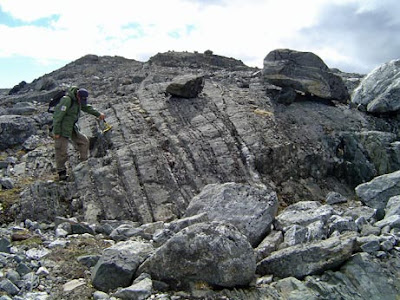
Oldest Known Ocean Crust Found on Greenland
"Scientists have discovered a 3.8-billion-year-old rock formation in Greenland that they say is the earliest example of oceanic crust ever to be discovered.
"The find suggests that some processes of plate tectonics—the slow but steady drifting and collision of giant pieces of Earth's outer shell—may have begun much earlier than previously suspected.
--Mark Anderson
—Illustration courtesy Burning Gold Productions via National Geographic Channel
—Science
--Ker Than for National Geographic News


